

Cyclins are a family of proteins that function as master regulators of the cell cycle by binding to and activating their catalytic partners, the cyclin-dependent kinases (CDKs). Members of the cyclin protein family include cyclins A, B, D, and E. Early work by Nobel Laureate Prof. Bill Kaelin at the Dana Farber Cancer Institute showed that disrupting the function of cyclins in certain types of cancer cells that had dysregulated cell cycle control was synthetic lethal – meaning that these cancer cells were selectively killed while the growth of normal cells was unaffected. In this pioneering work, Prof. Kaelin’s group used large linear peptides to block the protein-to-protein interaction between a hydrophobic patch on the surface of the cyclin proteins and a so-called “RxL motif” on the surface of proteins that bind to the cyclins during the cell cycle. Attempts were subsequently made by pharmaceutical companies to develop small molecule drugs to block this intracellular protein-to-protein interaction, but the nature of the large hydrophobic patch – RxL interaction site meant that these efforts were not successful, and the cyclins were considered to be “undruggable.”
At Circle, we have applied our MXMO platform to develop potent and selective macrocycles that can inhibit this protein-to-protein interaction between various cyclins and the RxL motif on various proteins that bind to them. Our lead program is an oral dual-active Cyclin A/B RxL inhibitor that is synthetic lethal in tissue culture to a wide range of cancer types that have elevated E2F hallmark scores, including certain types of lung and breast cancers. In working on this target, we have developed a deep knowledge of the cyclin hydrophobic patch – RxL interaction and are applying this to research stage programs to develop oral macrocycles that target Cyclin D and Cyclin E. Cyclin D is upregulated in tumor types, which include hormone receptor-positive breast cancer. Cyclin E is upregulated in tumor types, including uterine and ovarian cancer, and is often associated with resistance to widely used cancer therapies such as CDK4/6 inhibitors.
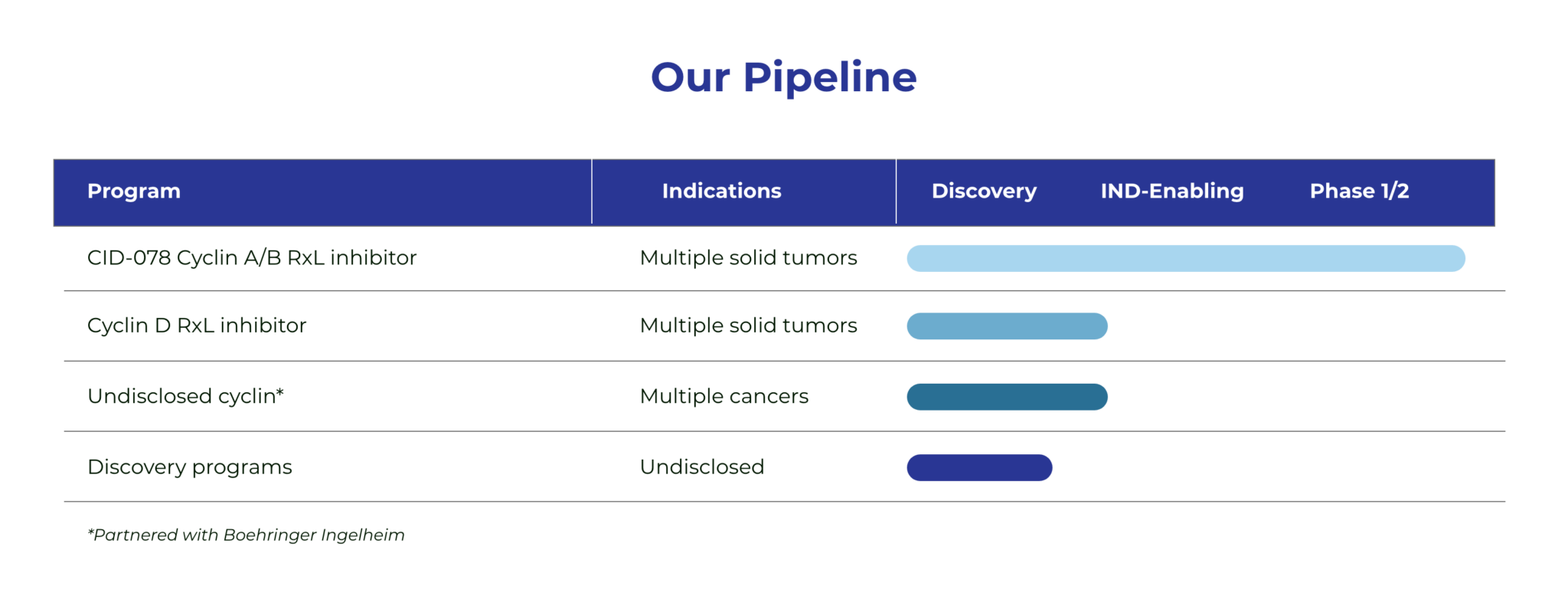

CID-078 is an investigational orally bioavailable macrocycle with dual cyclin A and B RxL inhibitory activity that selectively targets tumor cells with oncogenic alterations that cause cell cycle dysregulation. In biochemical and cellular studies, Circle Pharma’s investigational cyclin A/B RxL inhibitors have been shown to potently and selectively disrupt the protein-to-protein interaction between cyclins A and B and their key substrates and modulators, including E2F (a substrate of cyclin A) and Myt1 (a modulator of cyclin B). Preclinical studies have demonstrated the ability of these cyclin A/B RxL inhibitors to cause single-agent tumor regressions in multiple xenograft models. Based on these findings CID-078 has progressed to a Phase 1 clinical study (NCT06577987).
Cyclin D1 is a regulatory protein that plays a crucial role in cell cycle progression and is dysregulated in some malignancies, including ER-positive breast cancer and certain lymphomas. In these cancers, dysregulated cyclin D1 drives abnormal cell proliferation through its inactivation of the tumor suppressor retinoblastoma protein (Rb) leading to uncontrolled cell division. In preclinical studies, CID-165 has been shown to potently and selectively disrupt the cyclin D1-Rb interaction allowing Rb to remain active and suppress cancer cell proliferation. CID-165 is a first-in-class, orally bioavailable, macrocyclic cyclin D1 RxL inhibitor that has demonstrated robust anti-tumor activity in cyclin D1-driven preclinical cancer models, including in combination with other therapies such as CDK4/6-dual inhibitors, CDK4-selective inhibitors and endocrine therapies.
CID-078 is an investigational orally bioavailable macrocycle with dual cyclin A and B RxL inhibitory activity that selectively targets tumor cells with oncogenic alterations that cause cell cycle dysregulation. In biochemical and cellular studies, Circle Pharma’s investigational cyclin A/B RxL inhibitors have been shown to potently and selectively disrupt the protein-to-protein interaction between cyclins A and B and their key substrates and modulators, including E2F (a substrate of cyclin A) and Myt1 (a modulator of cyclin B). Preclinical studies have demonstrated the ability of these cyclin A/B RxL inhibitors to cause single-agent tumor regressions in multiple xenograft models. Based on these findings CID-078 has progressed to a Phase 1 clinical study (NCT06577987).
Cyclin D1 is a regulatory protein that plays a crucial role in cell cycle progression and is dysregulated in some malignancies, including ER-positive breast cancer and certain lymphomas. In these cancers, dysregulated cyclin D1 drives abnormal cell proliferation through its inactivation of the tumor suppressor retinoblastoma protein (Rb) leading to uncontrolled cell division. In preclinical studies, CID-165 has been shown to potently and selectively disrupt the cyclin D1-Rb interaction allowing Rb to remain active and suppress cancer cell proliferation. CID-165 is a first-in-class, orally bioavailable, macrocyclic cyclin D1 RxL inhibitor that has demonstrated robust anti-tumor activity in cyclin D1-driven preclinical cancer models, including in combination with other therapies such as CDK4/6-dual inhibitors, CDK4-selective inhibitors and endocrine therapies.